




Key takeaways
- In our TPC-C benchmark tests, conducted in 2024, MariaDB Cloud consistently outperformed AWS RDS Aurora in both throughput and latency across all workloads, delivering up to 3x higher throughput and 2.5x lower latency.
- Also, MariaDB Cloud demonstrated up to 7.5x better price-performance on Cost per Million Transactions for the benchmark workloads.
How Does MariaDB and AWS Aurora Compare?
When customers using AWS Aurora approach us, they typically focus on key attributes such as latency under high concurrency, availability during failures, and price-performance efficiency for their workloads. Although discussions often gravitate toward large-scale data volumes, most operational databases are actually modest in size, ranging from hundreds of gigabytes to a few terabytes.
Despite the wealth of information on Aurora’s storage engine, finding clear and straightforward third-party benchmark results has proven difficult. We discovered a simple TPC-C benchmark run that compares different RDS engine flavors, including MySQL and MariaDB, which provided some clarity. Additionally, we observed performance trends for MySQL and MariaDB over time, noting that modern MariaDB consistently outperforms modern MySQL in sysbench tests.
These insights spurred our curiosity about how MariaDB fares against MySQL in a fully managed cloud environment that includes several other components beyond just the DB engine, such as firewall, secure connections, network performance with encryption, compute-storage separation, continuous health monitoring. And, customers, crucially, want to understand price-to-performance ratios. Hence, it made sense to compare MariaDB Cloud (a fully managed DB service) with AWS Aurora.
In this post, we compare MariaDB Cloud running MariaDB 11.4 to AWS Aurora running MySQL 8.0.xx using Carnegie Mellon Database Group’s BenchBase tool running the TPC-C benchmark. TPC-C, developed by the TPC council, evaluates OLTP system performance by simulating the workload of an order-entry environment, akin to an e-commerce system. TPC-C remains one of the most renowned TPC benchmarks. We also conducted a simple sysbench comparison to assess pure read-only performance across both platforms.
Benchmarking Methodology
Our approach mirrors typical customer usage of “fully managed” databases: selecting an appropriate instance size and storage configuration, and relying on the database service to self-optimize – everything from max concurrent connections, various buffers like Buffer pool, Sort, Temp Buffers, etc. We aimed to evaluate out-of-the-box performance.
We controlled the data volume and concurrent client load using two parameters: ‘warehouse count’ and ‘terminals’. Both were scaled from 100 to 400 in our measurements. Additionally, all concurrent clients operated in “firehose” mode, meaning there was no think-time between transactions.
Configuration
MariaDB Cloud:
- Database Version: MariaDB 11.4 (latest LTS release)
- Instance Size: Scaled from 2 vCPU x 8 GB RAM for 100 concurrent clients to 16 vCPU x 128 GB RAM for 400 concurrent clients
- Storage Configuration: 500 GB gp3 storage, scaled from 10k IOPS and 500 MB/s throughput to 16k IOPS and 1000 MB/s throughput.
- Connection: Public IP endpoint for clients
Aurora:
- Database Version: Aurora MySQL 3.05.2 (Compatible with MySQL 8.0.32)
- Instance Size: Scaled from 2 vCPU x 16 GB RAM for 100 concurrent clients to 16 vCPU x 128 GB RAM for 400 concurrent clients
- Storage Configuration: Default Aurora storage for maximum IO speed.
- Connection: Public IP endpoint for clients
Both deployments were in AWS’s us-east-1 region, with clients and servers in the same Availability Zone to eliminate inter-AZ network jitter.
Results and Observations
We measured the total transactions per second (TPS) rate (throughput) and 95th percentile latency with an increasing number of warehouses and concurrent threads, ranging from 100 to 400.
We first measured TPS and latencies with increasing load – 100 threads to 400 threads on the same 8 core, 64GB server. The results are below
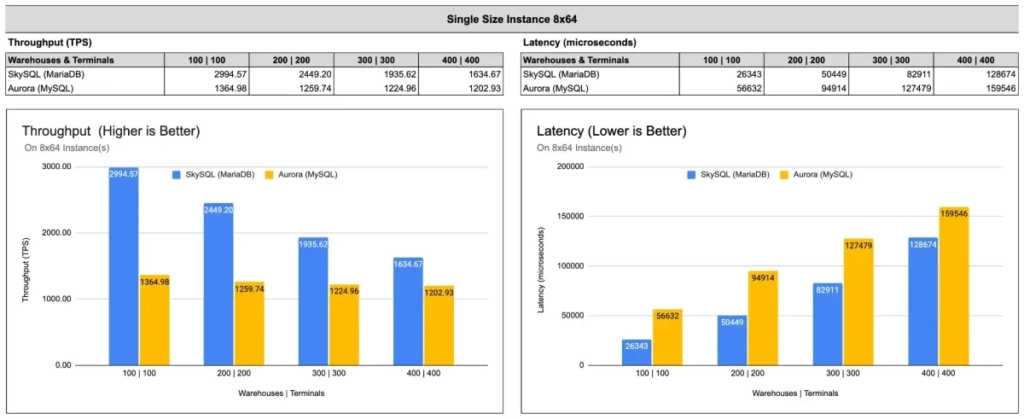
As expected, with increased load and threads bombarded with non-stop requests, the CPUs spend significant time in OS scheduling and increased IO contention resulting in reduced throughput.
Then, we scaled everything together – the load, the instance size and the data volume (warehouse count). We started with a small 2 core server for 100 concurrent clients and went up to 16 cores with 128 GB to handle 400 concurrent clients. The results are shown below.
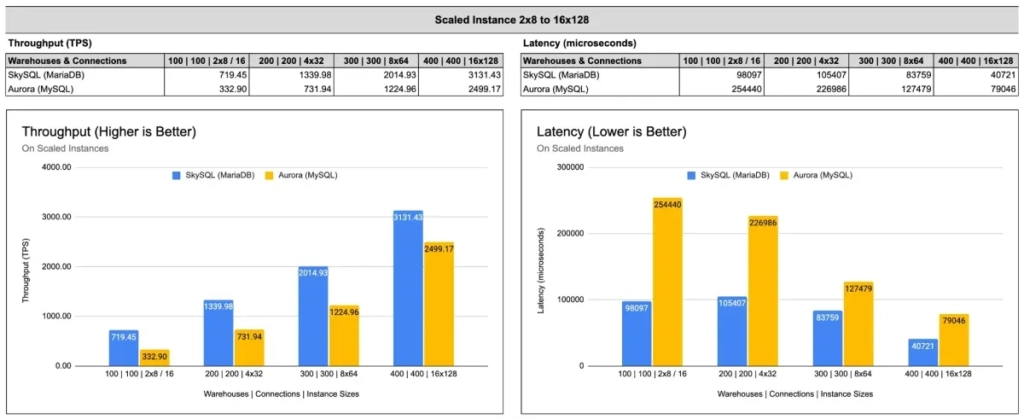
MariaDB Cloud consistently outperformed Aurora in throughput and latency across all workloads, with the most significant difference observed at the lower end of the spectrum. The throughput gains ranged from over 3X to about 23% at the highest scale factor. Similarly, MariaDB Cloud maintained significantly lower latencies compared to Aurora.
The primary performance difference can be attributed to the use of MariaDB 11.4 in MariaDB Cloud compared to MySQL 8.0.x in Aurora. As we scale the threads, we notice that the performance delta begins to decrease. When operating in a “firehose” manner, lock contention in InnoDB begins to increase. This contention arises from several factors:
- Dirty Page Flushes: Transactions are locked out during the flushing process.
- Lock Escalation: Row-level locks escalate to page-level locks under high contention.
- Buffer Pool Management: While the BufferPool in MariaDB Cloud is sized proportionally to the available memory, it is conservatively configured. No tuning (e.g., adjusting InnoDB writer threads) was performed, adhering to the typical customer usage of fully managed databases, which involves minimal low-level tuning.
In contrast, Aurora delegates all Transaction log management to its distributed storage layer, which likely benefits from a larger, distributed memory management system with fewer lock contention issues. However, due to the opaque nature of Aurora’s storage layer, we cannot directly validate these assumptions.
It’s important to consider the Quality of Service (QoS) at the storage layer. Aurora creates four copies of each transaction for redundancy, while MariaDB Cloud also provides redundant replication at the storage level to safeguard against failures. The critical attribute for customers, however, is the full high availability (HA) of the database service. Redundant disk block copies are insufficient if the Aurora MySQL server itself crashes. In several comparative runs between MariaDB Cloud’s “replicated topology” and Aurora, we observed similar results, which we plan to detail in future updates.
‘Read only’ Test using a Microbenchmark
To understand how each product performs without the storage layer’s influence (ensuring a more apples-to-apples comparison), we conducted a simple “point select” test using sysbench with increasing concurrency. The data set was intentionally kept small enough to fit entirely into each server’s BufferPool.
Configuration
- MariaDB Cloud: 8×32 instance
- Aurora: 8×64 instance
The larger memory allocation for Aurora was not a factor, as the data set was much smaller. Specifically, we used 10 tables, each containing 200,000 rows. Each row in sysbench is relatively small, consisting of a few integers and small strings. No tuning was applied to either product to keep the test conditions as close to default configurations as possible.
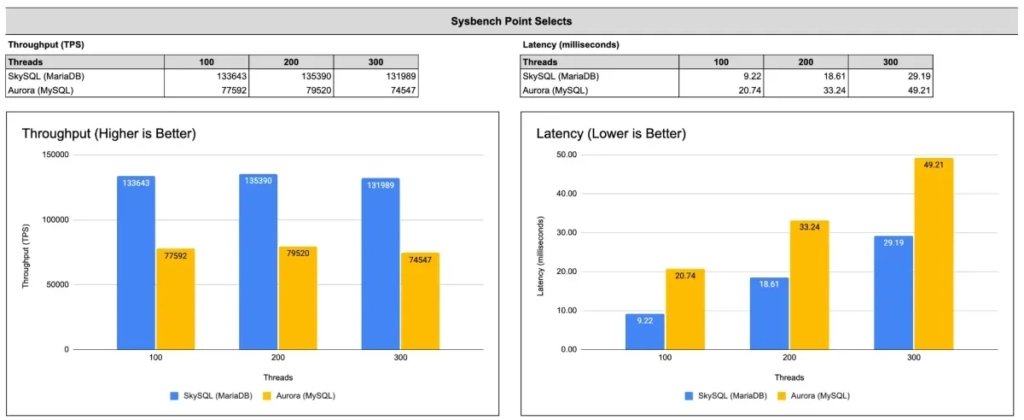
Benchmark Results and Observations
The results, as illustrated in the accompanying charts, aligned with our expectations. MariaDB Cloud demonstrated roughly 40% higher throughput compared to Aurora. This throughput remained consistent across all workloads, given that the test utilized the same capacity for each. Notably, 100 concurrent threads were sufficient to fully max out the available capacity.
In terms of latency, MariaDB Cloud exhibited a performance advantage, with latency measurements being approximately 50-60% lower than those of Aurora. As anticipated, latency degraded with increasing concurrency, but MariaDB Cloud maintained a superior performance profile throughout.
Price-Performance Comparison on MariaDB and Aurora
Customers running their workloads on Aurora often express concerns about high and unpredictable costs, particularly related to IOPS. Since Aurora charges separately for I/O operations, workloads with high read and write demands can result in significantly higher cost. During our benchmark tests, we observed that write IOPS hovered around 500k to 1 million operations per 5-minute interval (See screenshot from Aurora monitoring below). Interestingly, volume reads were minimal, indicating that most read transactions were handled at the buffer cache level. However, in a real-world scenario, volume reads would also contribute to Aurora’s costs.
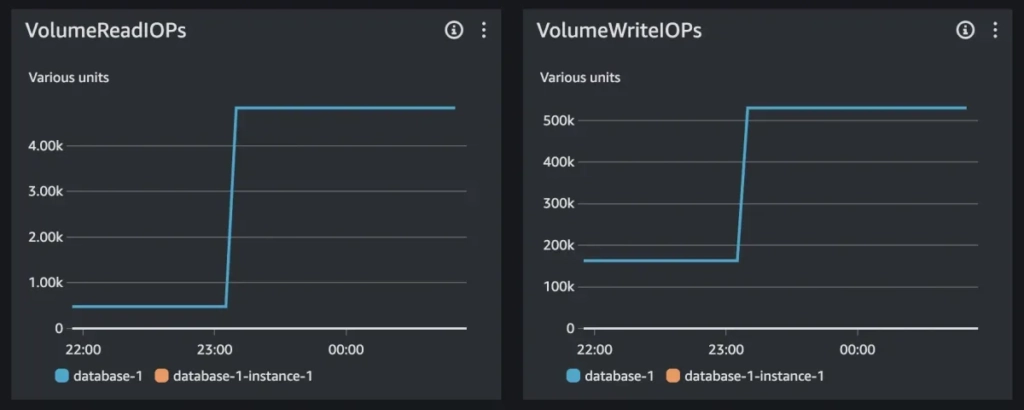
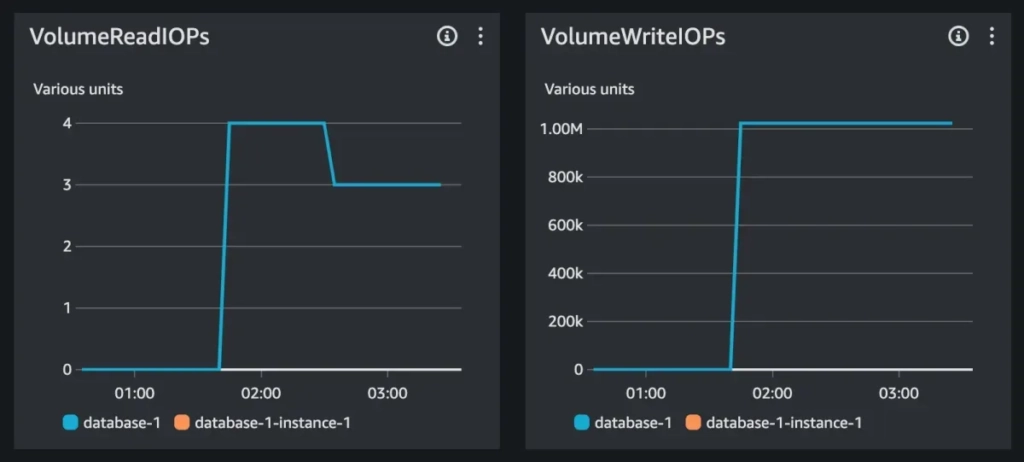
We priced the MariaDB Cloud and AWS Aurora configurations used for benchmarking as well as volume IOPS usage data for Aurora during the benchmark runs to estimate the costs of running the 5-min workloads. As illustrated in the chart on the left below, Aurora costs were at least 2 to 5 times higher compared to MariaDB Cloud for the various DB configurations used.
Combining the throughput benchmarks with the pricing estimates for running these tests, we calculated Cost per Million Transactions (CPMT) using the following formula. This gives the cost to process a million transactions, providing a direct comparison of how efficiently each platform handles workloads relative to their costs.
CPMT = (Cost per Second) / (Throughput per Second) x 1000000
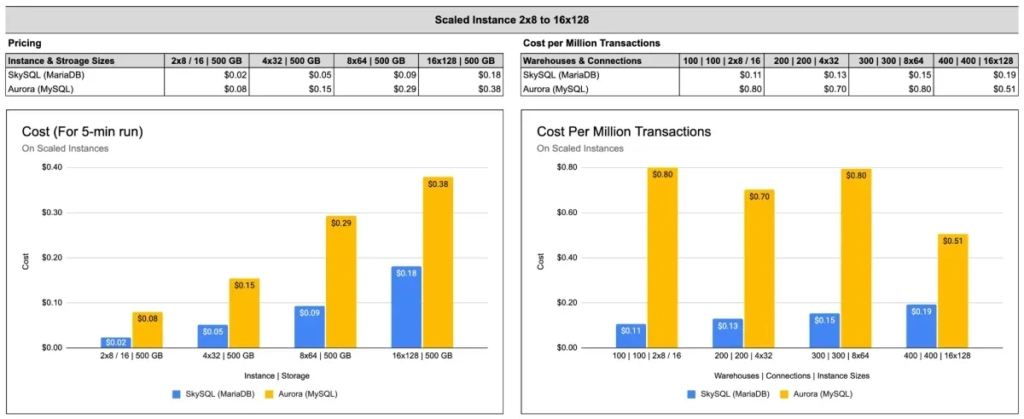
As expected, MariaDB Cloud showed a significant advantage compared to AWS Aurora with cost per million transactions coming up to 7.5 times lower. Although Aurora’s CPMT reduces as instance size and concurrency scales, MariaDB Cloud still delivered CPMT 2.5 times lower than that of Aurora at the highest benchmark scale.
MariaDB Delivers Better Throughput
Our benchmarking results highlight the significant advantages of MariaDB Cloud over AWS Aurora, both in terms of performance and cost-efficiency. MariaDB Cloud consistently delivered superior throughput, lower latency, and significantly reduced costs, making it an excellent choice for organizations looking to optimize their database operations.
If you’re ready to experience the benefits of MariaDB Cloud for yourself, we invite you to try it out here. Whether you’re migrating from another platform or starting a new project, MariaDB Cloud offers the performance and value that modern workloads demand.
We’re always here to help. If you have any questions or feedback, please contact us.
Frequently Asked Questions
In MariaDB’s TPC-C benchmark testing, MariaDB Cloud (MariaDB 11.4) consistently delivered higher throughput and lower latency than AWS Aurora (MySQL 8.0), with up to 3x higher throughput and up to 2.5x lower latency across the tested workloads. The largest advantage appeared at lower concurrency; at the highest scale the throughput lead narrowed to about 23%.
On a cost-per-million-transactions basis, MariaDB Cloud was up to 7.5x more cost-efficient than AWS Aurora in the benchmark, and still 2.5x more cost-efficient even at the highest scale tested. Measured purely on infrastructure, the equivalent Aurora configurations cost roughly 2 to 5 times more than MariaDB Cloud.
A major driver is that Aurora bills I/O operations separately, so read- and write-heavy workloads accrue additional cost on top of compute and storage. During the benchmark, write IOPS reached roughly 500,000 to 1 million operations per five-minute interval, and in production, volume reads would add further cost. MariaDB Cloud’s pricing avoids these separate per-I/O charges, making total spend more predictable.
Cost per Million Transactions is a price-performance metric that divides the cost per second of running a database by its throughput per second, scaled to one million transactions. It shows how efficiently a platform converts spend into completed work, making it a fairer comparison than looking at raw price or raw speed alone.
The comparison used the TPC-C benchmark, an industry-standard OLTP test that simulates an order-entry workload similar to e-commerce, run via Carnegie Mellon Database Group’s BenchBase tool. A separate sysbench “point select” test measured pure read-only performance, where MariaDB Cloud showed roughly 40% higher throughput and 50–60% lower latency.
MariaDB Cloud ran MariaDB 11.4 (the latest LTS release) and Aurora ran MySQL 8.0-compatible Aurora. Instances scaled together from 2 vCPU up to 16 vCPU / 128 GB RAM as client load grew from 100 to 400 concurrent connections, both in AWS us-east-1 with clients and servers in the same Availability Zone to remove network jitter. Neither database was manually tuned, reflecting typical “fully managed” out-of-the-box usage.
Yes. MariaDB Cloud provides redundant replication at the storage layer to protect against failures, and offers a fully high-available replicated topology so the service stays online even if a database node itself crashes — not just redundant disk copies. Comparative HA runs against Aurora showed similar availability behavior.
Yes. MariaDB maintains strong MySQL compatibility, so most applications move over with minimal code or configuration changes, and MariaDB Cloud is designed to support both migrations from other platforms and greenfield projects.
The advantage is largest at lower concurrency and narrows as load increases, because InnoDB lock contention (dirty-page flushes, lock escalation, buffer-pool pressure) grows under sustained “firehose” traffic. Even so, MariaDB Cloud led on throughput, latency, and cost-efficiency across every scale tested, remaining 2.5x more cost-efficient at the top end.