



Key takeaways
- Serverless works well for bursty workloads: It offers cost-efficient agility for prototyping and unpredictable AI traffic by auto-scaling resources.
- Watch for hidden traps: Serverless adoption can introduce challenges like connection management, “cold start” latency, and reduced observability compared to traditional databases.
- Match architecture to criticality: Use serverless for early-stage or fluctuating needs, while reserving provisioned infrastructure for steady applications to ensure predictable performance.
The promise of “serverless” is attractive to AI developers. Serverless is a cloud computing model that abstracts away infrastructure management, allowing developers to focus on building applications that scale automatically based on demand while paying only for the resources they consume. It sounds great, but are developers having success using serverless architecture that truly supports the high-stakes, performance-sensitive world of AI?
While serverless excels at handling unpredictable workloads, it introduces unique challenges when applied to databases. There are some hidden traps. For example, firing up database connections again when you stop and start the database is one difficult area. You need to understand when to leverage serverless models and when to migrate to provisioned instances.
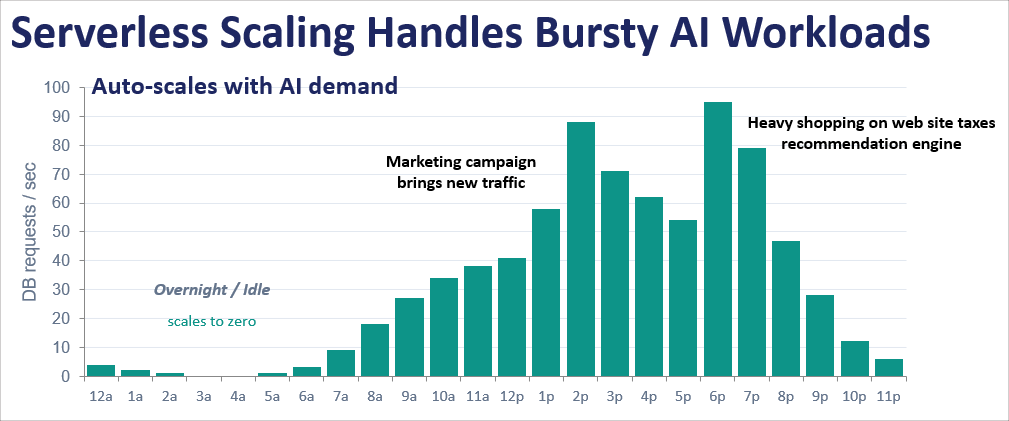
Serverless scaling handles unpredictable or uneven AI analytics workloads
Why Many AI Applications Fit Serverless Databases
Many AI workflows, particularly those built around Retrieval-Augmented Generation (RAG) or LLM agents, are inherently bursty. Serverless databases align with these patterns:
- Unpredictable/Spiky Traffic: An AI chatbot may sit idle overnight but face a massive spike during a marketing campaign. Serverless auto-scaling handles this elasticity without manual intervention.
- Development and Prototyping: For side projects and MVPs, “scale-to-zero” prevents unnecessary costs when the system isn’t in use.
- Vector Search Requirements: Modern serverless databases often include native vector search, allowing developers to consolidate transactional data and vector embeddings in a single platform.
What are the Hidden Traps of Serverless AI
Treating a database like a stateless serverless function is a mistake. Unlike application code, a database requires a persistent state. When you move to a serverless database, watch for these common friction points:
- Connection Management: Some DBaaS solutions provide only an endpoint, forcing you to build your own connection logic.
- Cold Starts and Latency: If your database scales to zero, your application may experience “resume latency,” resulting in timeouts or failed queries during the initial request.
- Hidden Egress Costs: Data transfer out of a cloud provider can be a silent budget-killer that is difficult to forecast.
- Reduced Observability: Self-managed databases allow for deep inspection of logs and metrics. In many DBaaS models, your visibility is limited by what the provider chooses to expose.
When to Move from Serverless to Provisioned
Serverless is not for everyone. If your AI application is mission-critical, high-volume, and “always-on,” a fully provisioned architecture is often superior. This applies to:
- AI-powered search engines with steady, high query volumes.
- Real-time recommendation systems that cannot tolerate cold start latency.
- Production-grade coding assistants embedded into core development workflows.
In these scenarios, provisioned servers provide the predictable performance characteristics necessary for high-volume operations.
Can you host both Serverless and Provisioned AI?
To build production-ready AI apps, you shouldn’t have to choose between developer agility and database performance. MariaDB Cloud was designed to abstract away the friction of serverless:
- Seamless Connection Management: By using a database proxy (MaxScale) between the application and the database, your app remains connected even when scaling to zero. This eliminates the “cold start” wait.
- Transparent Pricing: Egress charges are passed through at cost, removing the unpredictability of hidden cloud markups.
- Default Security: SSL is enabled by default, reducing the complexity of certificate management for the client.
- Granular Observability: MariaDB Cloud provides a metrics and logs API compatible with standard tools like Prometheus and Datadog, giving you the visibility of a self-managed instance with the convenience of a managed service.
Choosing the Right Path for Your Application
The most resilient architecture is one that evolves with your application. MariaDB Cloud offers both serverless and provisioned options on the same platform.
- Serverless: Perfect for early-stage development, demos, and unpredictable traffic patterns.
- Provisioned: Switch to provisioned infrastructure to unlock dedicated capacity and predictable performance.
By selecting an architecture that matches your specific development stage, you ensure that your infrastructure supports your growth rather than hindering it.
Ready to build your next AI application? Try MariaDB Cloud serverless for free or watch our introduction video to learn more.