


MariaDB Enterprise Kubernetes Operator
01 Introduction
MariaDB Enterprise Kubernetes Operator is a powerful solution designed to seamlessly provision and operate MariaDB Enterprise Platform within Kubernetes environments. Certified by Red Hat and supporting the latest three Kubernetes versions across all CNCF-certified distributions, Enterprise Kubernetes Operator offers a standardized, efficient, and secure way to manage the entire lifecycle of your enterprise database fleet across any cloud or on-premises infrastructure.
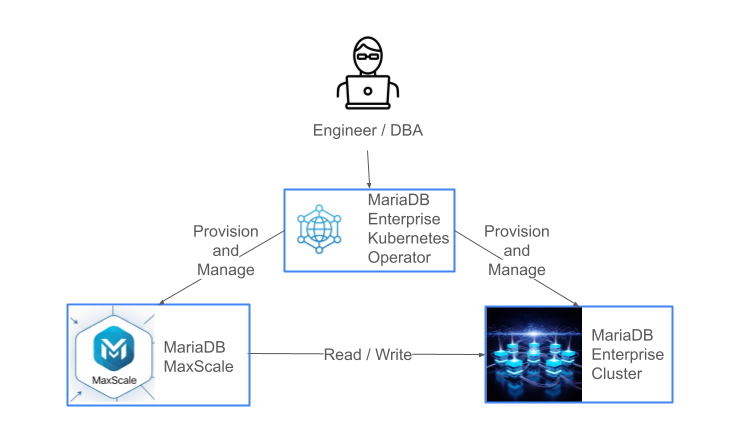
As an extension of the Kubernetes API, the Enterprise Kubernetes Operator uses Custom Resource Definitions (CRDs) to encapsulate the operational knowledge of an expert database administrator. This allows you to declaratively define and manage production-ready MariaDB topologies, including high-availability Galera clusters and load-balanced MaxScale environments, directly through standard Kubernetes manifests.
02
Benefits of MariaDB
Enterprise Kubernetes Operator
Beyond the obvious benefit of standardizing deployment methods, the Enterprise Kubernetes Operator delivers a host of other advantages.
The Kubernetes Operator automates and standardizes the provisioning and management of highly available MariaDB Enterprise Clusters. It can also deploy MaxScale instances for intelligent query load balancing and read/write splitting. The Kubernetes Operator also performs high-speed non-blocking physical backups using native mariadb-backup or Kubernetes-native VolumeSnapshots.
Use the Kubernetes Operator to take, schedule and restore backups to and from any S3-compatible object storage. This also enables bootstrapping new database instances directly from existing backups. The Kubernetes Operator can be configured to perform automated, zero-downtime rolling updates for patches and version upgrades. It can issue, manage and rotate TLS certificates without downtime and integrate with cert-manager and external PKIs like HashiCorp Vault.
Enhanced Disaster Recovery & Resilience
Dramatically reduce your Recovery Time Objective (RTO) with high-speed, non-blocking physical backups orchestrated by the Kubernetes Operator. Control your Recovery Point Objective (RPO) with the new Point-in-Time Recovery (PITR), allowing for granular restores to an exact timestamp using automated binlog archiving.
Automate Full Lifecycle Management
Drastically reduce manual effort and human error by automating operations, including high-availability configurations, zero-downtime rolling upgrades, database parameters and backup/restore schedules.
Deploy Anywhere with Confidence
Standardize database deployment across any public cloud, private cloud, or on-premises environment. Support now includes IBM Power (ppc64le) alongside x86_64 and arm64 architectures, S3-compatible object storages and Microsoft Azure Blog Storage.. The Operator provides a consistent, repeatable process managed through infrastructure-as-code (IaC) principles.
Enterprise Support
Gain peace of mind and reliable operations with MariaDB Enterprise Server and MaxScale deployments, supported on the last three minor versions of CNCF-certified Kubernetes distributions and validated with the latest Red Hat OpenShift EUS versions (including 4.16).
Enhanced Security & Compliance
Meet stringent security and compliance requirements in regulated environments. Leverage fully customizable certificate lifecycles, advanced private key algorithms and strict TLS enforcement.
Observability
Gain proactive insight into database health and performance. The Kubernetes Operator natively exports Prometheus metrics for both MariaDB Enterprise Server and MaxScale, enabling rich visualization in Grafana dashboards and real-time alerting.
03 Key Features
- Provision and manage highly available MariaDB Enterprise Clusters (using Galera).
- Perform granular Point-in-Time Recovery (PITR) for primary/replica topologies by combining physical backups with interval-based binlog archiving.
- Deploy MaxScale instances for intelligent query load balancing and read/write splitting.
- Perform high-speed non-blocking physical backups using native mariadb-backup or Kubernetes-native VolumeSnapshots.
- Take, schedule, and restore backups to and from S3-compatible object storage or Microsoft Azure Blob Storage.
- Take, schedule and restore backups to and from any S3-compatible object storage.
- Bootstrap new database instances directly from existing backups.
- Perform automated, zero-downtime rolling updates for patches and version upgrades.
- Issue, manage and rotate TLS certificates without downtime.
- Integrate with cert-manager and external PKIs like HashiCorp Vault.
- Dynamically provision and expand persistent storage on any cloud provider.
04 MariaDB Enterprise Kubernetes Operator versus Community Operator
| Feature | MariaDB Enterprise Kubernetes Operator | MariaDB Community Kubernetes Operator |
|---|---|---|
| Enterprise Support | – Annual LTS releases (25.10) – The latest three versions of Kubernetes (All CNCF-certified distributions) – Available in Google Distributed Cloud (GDC) air-gapped marketplace | No |
| Red Hat OpenShift Certification | Certified with the two most recent OpenShift Extended Update Support (EUS) versions | No |
| Non-Blocking Physical Backups | Leverages BACKUP STAGE feature, minimizing read locks and service interruptions | No |
| IBM Power Architecture Support | Full support for the ppc64le architecture | No |
| Database Plugins | Pre-packaged Auth & Key-Management Plugins | No |
| Base Image | Certified, signed, and scanned Red Hat UBI base | Standard Community images |
| Supported Products | MariaDB Enterprise Server and MaxScale | MariaDB Community Server and MaxScale |
| Certificate Lifetime | Fully customizable to meet policy requirements | Fixed at 90 days |
| Private Key Security | ECDSA & RSA with configurable key lengths | ECDSA only (P-256) |
| Advanced TLS Support | Enforce strict TLS versions and policies | Basic TLS support |
| Advanced Point-in-Time Recovery (PITR ) | Parallelized upload/download of binlogs to/from object storage. Binlog retention policy. | No |
05 About MariaDB
MariaDB seeks to eliminate the constraints and complexity of proprietary databases, enabling organizations to reinvest in what matters most – rapidly developing innovative, customer-facing applications. Enterprises can depend on a single complete database for all their needs, that can be deployed in minutes for transactional, analytical and hybrid use cases. Trusted by organizations such as Deutsche Bank, DBS Bank and Samsung – MariaDB delivers customer value without the financial burden of legacy database providers. For more information, please visit mariadb.com.
Contact Us to Learn More About MariaDB