


MariaDB In-Memory Cache and Data Grid
Distributed In-Memory Caching and Compute for
Real-Time Data Processing and AI Agentic Apps
MariaDB’s acquisition of GridGain and its distributed in memory technology extends the capabilities of the MariaDB Enterprise Platform by providing customers a native cache and compute layer that sits between your applications and systems of record. It moves hot data and read-intensive workloads into a shared-nothing, horizontally scalable memory tier, delivering sub-millisecond response times, ANSI SQL, ACID guarantees, and colocated compute. The platform enables AI/ML and agentic apps by providing vector search for retrieval-augmented generation (RAG), semantic caching, agent memory, fast feature serving, and real-time ML model execution for decision-making and in-transaction analytics.
HOW IT WORKS
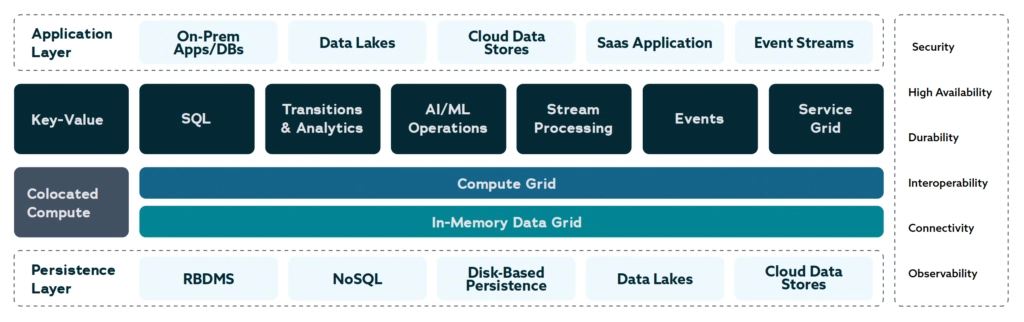
MariaDB In-Memory Cache (GridGain) deploys as a peer-to-peer cluster of server nodes that partition data across cluster RAM with configurable backup copies. A shared-nothing design removes single points of failure; adding nodes automatically rebalances data and scales throughput and capacity linearly to millions of transactions per second (TPS) and petabytes of data.
Applications connect through ANSI SQL (JDBC/ODBC) or native key-value APIs. Support for read-through, write-through and write-behind patterns keep the cache consistent with MariaDB or any other system of record, while native persistence can store the full dataset on disk, so the cluster restarts instantly without a warm-up window.
Compute runs where the data lives. Colocated processing, continuous queries and streaming ingest eliminate network round trips, so complex calculations execute against live data in milliseconds rather than in overnight batch.
WHERE CUSTOMERS DEPLOY IT
- Real-time risk management – Process streaming data and execute business rules, models and optimizations as events occur, rather than in overnight batch.
- Embedded smart decisions – Run analytical and AI/ML models inside the transaction to drive risk analysis, fraud checks, dynamic pricing and personalized offers at the moment of interaction.
- Converged transactional analytics (HTAP) – Execute complex models against live transactional and streaming data without ETL into a separate analytics store.
- High-throughput transaction processing – Scale demanding OLTP workloads with durable, ACID-compliant in-memory processing at millions of operations per second.
- Low-latency 360° view – Consolidate and curate data from disparate systems of record into a single real-time hub serving applications in milliseconds.
- Ultra-low latency at massive scale, enabling sub-millisecond access
- Distributed in-memory architecture delivers massively parallel processing and linear scale-out to millions of TPS
- Colocated compute provides execution of business logic where the data resides, reducing network data movement and disk I/O
- Transactional and analytical processing (HTAP) on a single platform
- ACID compliance, full ANSI SQL and disk-based persistence for data management and storage flexibility
- Continuous availability across racks, data centers and clouds
- Lower infrastructure spend by offloading non-core database operations and reducing mainframe MIPS
- One vendor and one support contract for the full data delivery stack
PROVEN IN PRODUCTION
- Top 10 customers in banking, telcos and airlines
- 300x faster risk calculations, 3 minutes to 600ms at a global Top 5 bank
- 99.999% availability sustained for 5+ years at a large telco solutions provider
- 200K transactions per second at a national credit registry
“We are colocated with the data, so we can take advantage of zero network latency. We are now able to post transactions and do something with them in as little as 20 milliseconds.”
– Large U.S. regional bank
EXPANDING THE CAPABILITIES OF THE MARIADB ENTERPRISE PLATFORM
MariaDB In-Memory Cache brings distributed in-memory cache and computing natively into the MariaDB environment — not as a bolt-on, but as a deep integration built for mission-critical data.
- Sub-millisecond latency. Move hot data from disk to RAM and turn minute-long queries into millisecond responses.
- Frictionless implementation. Deploy as a transparent query cache in front of MariaDB with zero application code changes.
- Architectural consolidation. Retire third-party caching layers and fragile batch and ETL pipelines in favor of one integrated ecosystem.
- Geo-distributed performance. Extend MariaDB’s reach with ultra-low latency across regions and data centers.
- Reduce the load. Absorb millions of requests by adding nodes, with linear performance as data and concurrent user traffic grows.
- Unified enterprise support. One partner, one contract and one expert team for the database and the cache.
UNIFIED DATA PLATFORM CAPABILITIES
| CAPABILITY | WHAT YOU GET |
|---|---|
| In-memory architecture | Durable off-heap memory storage with no noticeable Garbage Collection (GC) pauses, automatic defragmentation and predictable memory consumption. NUMA-aware allocation places data in the RAM closest to the processing core. Store 0–100% of data in memory or on disk. |
| Persistence | Native persistence stores a superset of the data on disk with a fully transactional write-ahead log. Query data whether it is in memory or on disk, and restart clusters instantly with no warm-up period. |
| SQL & transactions | ANSI-99 SQL with DDL and DML, distributed joins, cross-cache queries, indexes and aggregations. Fully distributed ACID transactions with user-configurable strict or eventual consistency. JDBC and ODBC drivers. |
| Data access APIs | Key-value (JCache JSR-107), SQL, scan, full-text and continuous queries. Native APIs for Java, .NET/C#, C++, Python, plus REST and thin clients. |
| Compute & analytics | Colocated compute executes logic on the nodes holding the data, eliminating network movement and enabling massively parallel processing. Compute grids, service grids and machine learning libraries run in-cluster. |
| AI & vector search | Vector search for similarity and RAG-style retrieval. Feature extraction and model execution run in-transaction against live enterprise data. |
| Streaming & ingest | Confluent-certified connector for Apache Kafka, native Apache Spark integration for RDDs and DataFrames, and high volume data streamers for event-driven data ingestion and processing. |
| Data lake formats & JSON | SQL COPY imports and exports Apache Parquet, Apache Iceberg and CSV. Dedicated JSON functions accelerate semistructured and document workloads. |
| System-of-record integration | Read-through, write-through and write-behind with MariaDB, Oracle, SQL Server, PostgreSQL, Cassandra, MongoDB and Hadoop. Automatic schema import and data loading with no coding. |
| High availability & DR | Configurable backup copies, rack awareness, active-active and active-passive data center replication, and zero downtime rolling upgrades across the cluster. |
| Backup & recovery | Local and remote full and incremental snapshots with point-in-time recovery, plus compressed snapshots for persistent clusters. |
| Security | Authentication and role-based authorization, TLS/SSL transport encryption, transparent data encryption at rest, audit logging and multi-tenancy hardening. |
| Observability & management | GridGain Control Center for cluster administration, OpenTelemetry-compatible metrics, customizable dashboards, alerting, query tracing and tuning. |
| Flexible deployment | Bare metal, VM or Docker; Kubernetes and OpenShift via the certified operator; AWS, Azure and Google Cloud; hybrid, multicloud and inter-cloud topologies. |
Contact Us to Learn More About MariaDB