Use Case
Accelerate Now, Migrate When Ready
The database is usually what limits the legacy application. Put an in-memory layer in front of it to fix performance today, and replace it on your own schedule.
What is application modernization?

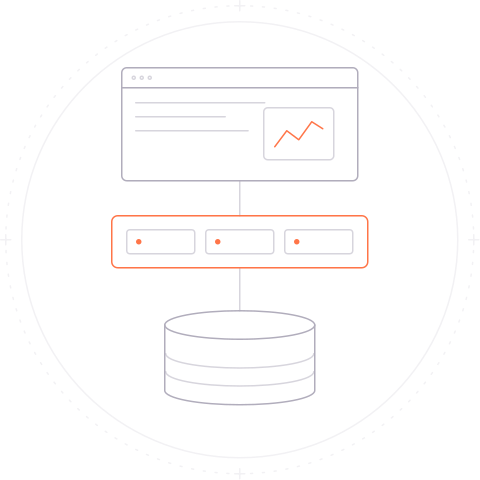
Application modernization updates the code, architecture and data infrastructure of legacy apps to meet modern business needs. The database can be both a bottleneck and an enabler. MariaDB GridGain delivers speed and scale now, and MariaDB Enterprise Server provides a modern open database for when you’re ready to migrate.
How Samsung SDS cut database operating costs by more than half with MariaDB
The Knox Portal service migrated from Oracle to MariaDB, cutting operating costs by over 50% while serving more than half a million users.

Capabilities
What modernization actually needs
Modernization requires capabilities that let you improve the performance and scale of your applications now and easily migrate to a modern database when ready.
Distributed caching
Distributed caching in front of Oracle, DB2 and other databases, with read-through and write-through/write-behind patterns to keep the data in sync, with sub-millisecond latency and millions of transactions per second (TPS).
Distributed computing
Colocated in-memory computing and stream processing that runs joins, aggregations and custom code in memory, so analytics that depend on the legacy database run in milliseconds.
Polyglot persistence
Polyglot persistence supports multiple data types and stores the data durably, replacing the database.
Modern, open database
Modern, open database with Raft clustering and geo-replication for availability across regions, with vector search, integrated AI RAG retrieval and AI plug-ins for agentic workloads.
Oracle compatibility
Ability to migrate from Oracle while preserving Oracle PL/SQL syntax, sequences and data types, so existing schema and stored procedure logic can run without rewriting code.
Deploy anywhere
MariaDB Enterprise Server can be deployed in any environment: on premises, in your cloud or as a DBaaS managed service.
Modernization starts where you are
These are the three typical scenarios where customers use MariaDB Enterprise Platform.

You need performance and scalability now
Put MariaDB GridGain in front of the database. Distributed caching improves the application immediately, with no migration decisions required.
You’re refactoring a monolith into microservices
Use the in-memory data layer to enable the Command Query Responsibility Segregation (CQRS) pattern, separating reads and writes.
You’re ready to migrate
Move from Oracle or DB2 to MariaDB Enterprise Server, on premises or managed, leveraging the Oracle compatibility features to minimize code changes.
Recommended resources
Get started
Start building with MariaDB
One real-time database platform you can trust, for everything you run today and everything you build next.
Frequently asked questions
Application modernization updates legacy applications’ code, architecture and data infrastructure to meet modern business needs, improving scalability, reliability, security, and cost efficiency. The database is usually the limiting layer, so modernizing it can deliver significant benefits.
Yes. An in-memory cache and compute layer in front of the existing database absorbs read traffic and runs analytics on the collocated data in memory.
No. You can use both MariaDB and Oracle together. The in-memory acceleration offered by MariaDB GridGain sits in front of Oracle or another system of record so it stays in place, with no commitment to migrate. Native persistence in MariaDB GridGain means the data is already positioned if you decide to move later.
Start with an assessment that scopes the work, including a review of the Oracle PL/SQL stored procedures, sequences and data types that need to be carried over.
MariaDB understands Oracle PL/SQL syntax, sequences and data types, so existing Oracle schema and stored procedure logic can run on MariaDB without having to rewrite code. MariaDB Enterprise Server 12.3 includes support for (+) outer joins, XMLTYPE, associative arrays, SYS_REFCURSOR and multi-event triggers.
It depends on your requirements and whether you need to manage your own infrastructure. MariaDB Enterprise Platform runs on premises, in your own cloud account (BYOC) or as a fully managed DBaaS service on any hyperscaler, reducing the management burden. MariaDB offers the flexibility to choose the option that best fits your needs.