
Use Case
Turn Fragmented Data Silos into One Real-Time Operational View
When every request fans out across multiple source systems, latency becomes unpredictable and complexity increases. A digital integration hub provides a single, up-to-date operational view instead.
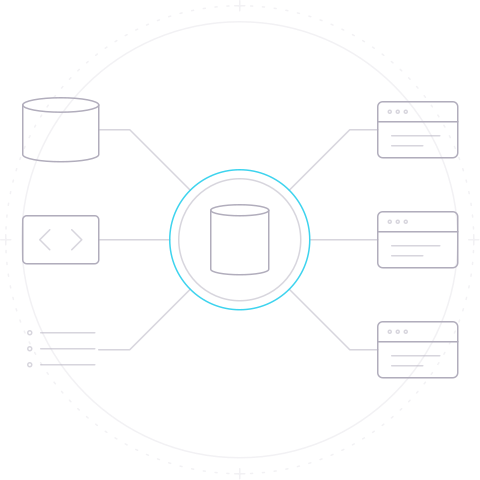
How does MariaDB GridGain act as a digital integration hub?

MariaDB GridGain enables a shared operational data layer in front of your systems of record. It continuously synchronizes data from databases, APIs and event streams into one operational view and serves it to many applications.
Capabilities
What a digital integration hub needs
A DIH has to serve many applications at once, stay current with its sources, and survive failure. Five capabilities in MariaDB GridGain make that possible.
Shared-nothing architecture
Data is partitioned across the cluster and compute is colocated with it, so reads and decision logic run locally. Scaling is linear with sub-millisecond latency.
In-memory performance with durability
Native persistence keeps data and indexes in memory while writing them to disk, so operational state survives restarts and datasets can grow larger than RAM.
Flexible access models
ANSI SQL for cross-domain distributed queries, including joins and aggregations, and key-value APIs for low-latency lookups.
Continuous synchronization
Load through DataStreamer, Kafka, CacheStore, APIs and source-side CDC, then process and publish changes downstream with Continuous Queries, keeping the hub current in both directions.
Decoupled API services
Applications and microservices read one governed layer instead of calling each source directly, reducing API traffic, source-system load and associated costs.
A digital integration hub enables any pattern that needs current data assembled from several systems at high concurrency
These four appear commonly in production.

Customer 360
Core entities often live across multiple systems that update on different timelines. The hub holds one current view with explicit freshness bounds, so applications no longer need to reconcile data at request time.
Real-time risk and reporting
Trades stream in as they happen, with aggregations running on arrival instead of overnight batches. One bank holds 6 TB and 300 million rows in memory.
Mainframe offload
Put the hub in front of the mainframe to serve high-volume, repetitive and CPU-intensive reads from a lower-cost distributed layer, reducing MIPS charges.
Hybrid and cloud migration
Build cloud-native services against the hub while keeping operational systems and regulated data stay on-premises and under your jurisdiction, without rippling and replacing infrastructure.
Recommended resources
Get started
Start building with MariaDB
One real-time database platform you can trust, for everything you run today and everything you build next.

Frequently asked questions
A digital integration hub is a shared, low-latency operational data layer. It synchronizes data from databases, APIs and event streams into one view, then serves many applications without each having to query the sources.
A warehouse is built for historical analytics on batch data. A digital integration hub serves current operational data to live applications. Most architectures keep both, with each handling the workloads it does best.
No. Application caches protect one backend for one application, with TTLs and invalidation. A DIH is shared infrastructure with transactional consistency, cross-domain SQL and a defined path for updates.
No. The hub sits in front of them. Your databases and mainframe stay authoritative, while the hub becomes the system of engagement for real-time reads and controlled updates.
Applications connect to one centrally managed layer instead of calling every source for each action. Ingesting data once and serving it to many consumers cuts API traffic, mainframe MIPS and duplicate infrastructure.
Yes. The hub decouples applications from sources, so cloud-native services access current data while operational systems and regulated records stay on-premises and within the your required jurisdiction.